
A birthday and a Holi-themed bloodbath




 years


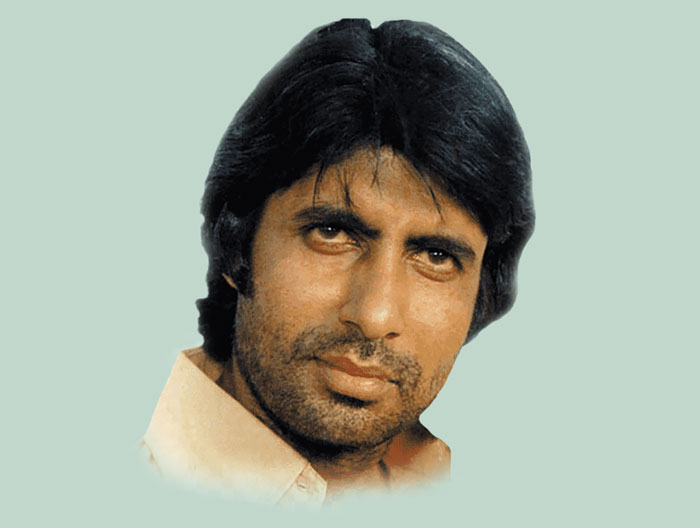
Amitabh Bachchan is the biggest star of them all. He is idolized in India, China, Malaysia, Russia, the Middle East, Germania, the UK, North Africa, and significant parts of everywhere else (except the USA). This is not hype. By any objective measurements—the number of tickets he has sold, the number of butts in seats, or maybe just the sheer numbers of people in the world who know his face—Amitabh has the fame of Chaplin in his prime, back when the Little Tramp was the best-known person in the world.
You can measure the love the world has for this man in other ways, too. When Elizabeth Taylor, at the height of her fame—the time of Cleopatra and Richard Burton and her Oscar for Butterfield 8—battled death from pneumonia with an emergency tracheotomy, no one set up shrines in their homes. In 1983 thousands did after Amitabh's near-fatal injury, an accident in a fight scene during the filming of the smash hit Coolie. Release prints froze the frame just before the incident and displayed the words "This is the shot in which AMITABH BACHCHAN was seriously injured." After a few seconds the film resumes, then the frame is frozen again as the near-fatal punch connects. The screenshot below shows the frame; click and you can watch the whole scene.
 The Big B was doing his own stunts, and somehow a pulled punch wasn't
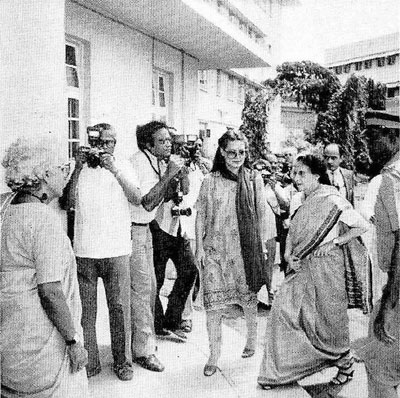
pulled. The stuntman striking the blow couldn't get a job for another four years; he was reviled as the actor with the “killer punch.” After a weeks-long crisis in the Breach Candy Hospital—as seen on the left, Indira Ghandi came to
visit—Amitabh eventually
rejoined the cast and finished the movie. With the injury still on the public's mind, however, pop-meister director Manmohan Desai reworked the climax so the battling porter did not die in the end. Unsurprisingly, Coolie went
on to become
the biggest film of the year.
One thing I'd like to point out if you’ve chosen to watch the segment: you're seeing a version where the top and bottom of the Academy-ratio original—almost square, like Hollywood movies until the 1950s—are cropped so that the film appears widescreen. This is common practice for Ultra, the company handling Amitabh pictures from this period; Shemaroo, the other big Bollywood distributor, does exactly the same thing. This will eventually change, I'm sure, but for now it's the only way to see a restored version. Another note: violence in Indian cinema has gotten a lot more sophisticated since 1983. It took a few years to make it to Bombay but the global shift to greater realism was seen in India, too, after that hugely influential 1967 release of Bonnie and Clyde.
Amitabh is the son of prominent Urdu poet Harivansh Rai Bachchan, husband of Jaya Badhuri (a star in her own right), father of Abhishek, a handsome young actor who—in a repetition of his father's rocky start—found success after a series of flops. One of the biggest female stars in Bollywood, former Miss Universe Aishwarya Rai, moved in with the Bachchan clan when she married Abhishek.
In his long career Amitabh has appeared in over two-hundred pictures, many of them mega-hits, many of them classics of Hindi cinema. (I’m writing this in 2026, and he’s still making movies.) I love him without reservation and recommend almost any film he has ever made, particularly his angry-young-man pictures from the 70s. Here are some of my favorites:
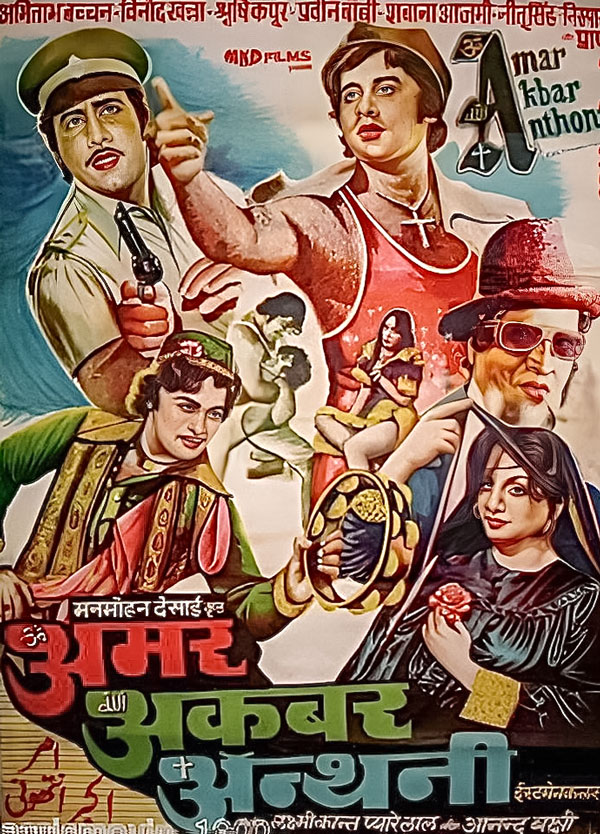
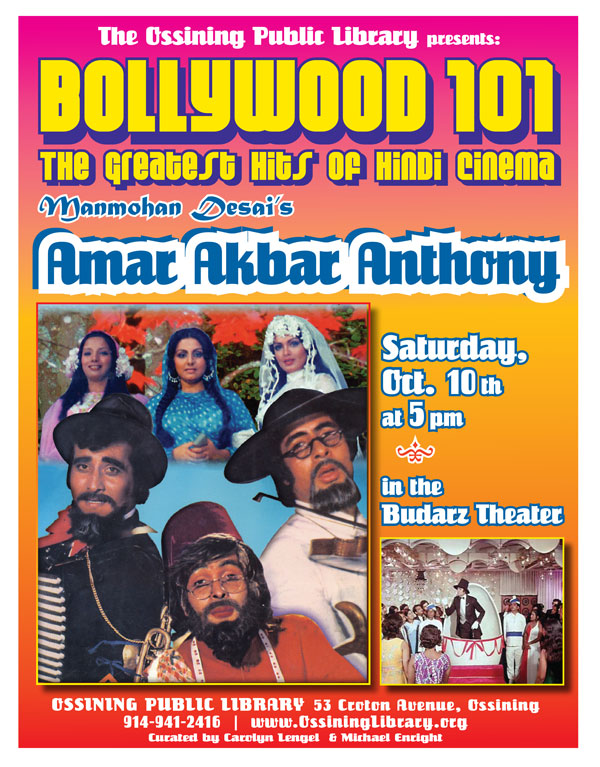
Another huge hit from Manmohan Desiai, the director of Coolie, AAA is an extremely campy and fast-moving film with enough plot for two Dickens novels. Amar Akbar Anthony is a excellent example of
the separated at birth
trope that has
fueled dozens of Bollywood screenplays over the years. 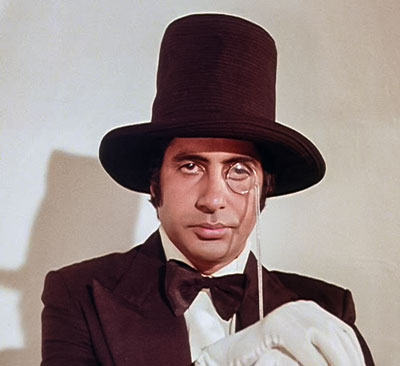 Three brothers, their father
on the run from an evil smuggler, are left in a park and respectively found by a Hindu, a Muslim, and a Christian. Each of the boys is consequently raised
in a different religious tradition, each unaware that their parents are still alive. They become friends as adults after meeting while donating blood to an injured woman. She is, of course, their mother, who can't recognize anyone since
she has gone blind. This is all before the credits, mind you! The high point of this wonderfully enjoyable film comes fairly early in the picture when Amitabh (seemingly dressed as Mr. Peanut) emerges from a giant Easter egg and sings the
classic
My Name is Anthony Gonsalvez.
There are few such delirious moments in all of cinema.
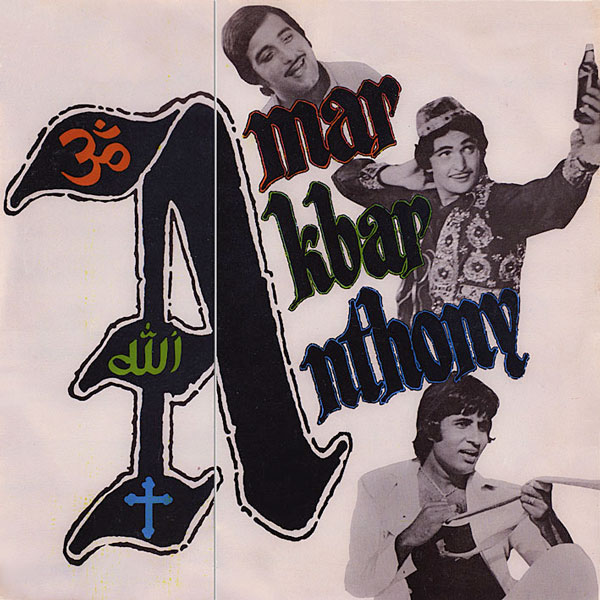
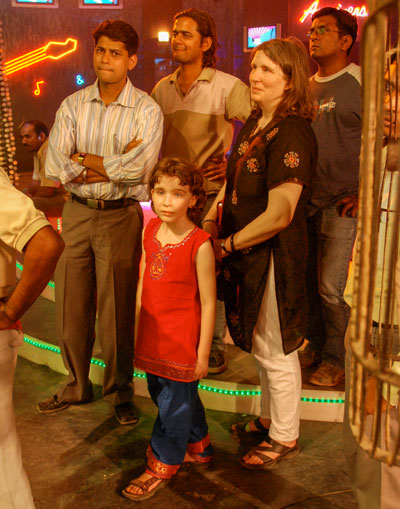
In 2007 when my family and I were in Mumbai, we visited the set of a comedy-romance called My Name is Anthony Gonsalvez, a commercially canny homage to Amar Akbar. As we were driving away my daughter began to sing the song, one of her favorites. Before the second line everyone in the van was singing along, Americans and Indians alike.
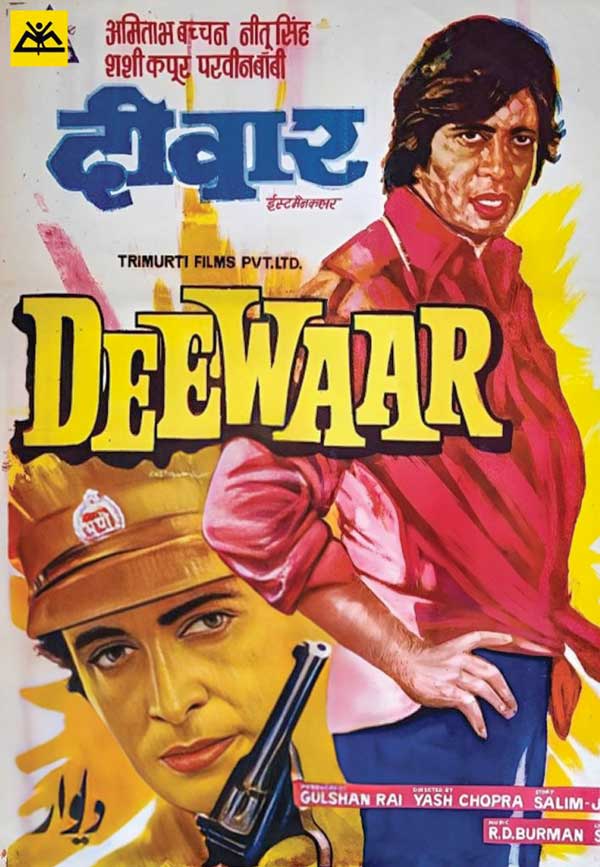
This film is one of the best examples of Amitabh as the angry young man (often named Vijay) in roles that defined the first phase of his career and turned him into a superstar. In film after gritty film the Big B would emerge from poverty to find success in Mumbai's underworld. Invariably events force him into vengeance, often towards a father-figure who has betrayed him. Often he dies, often in his mother's arms—as he does in this film, after a bloody struggle up the steps of a temple.
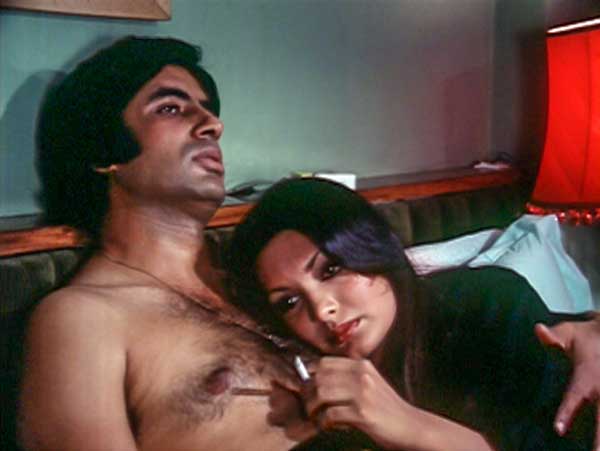
Yash Chopra was already on a path to become one the most successful directors in the industry. Chopra's films, throughly commercial, were full of innovations that were rapidly copied. He was one of the first to use extensive location shooting, showing the emerging middle class a whole new world outside of the studios and backlots of Mumbai.
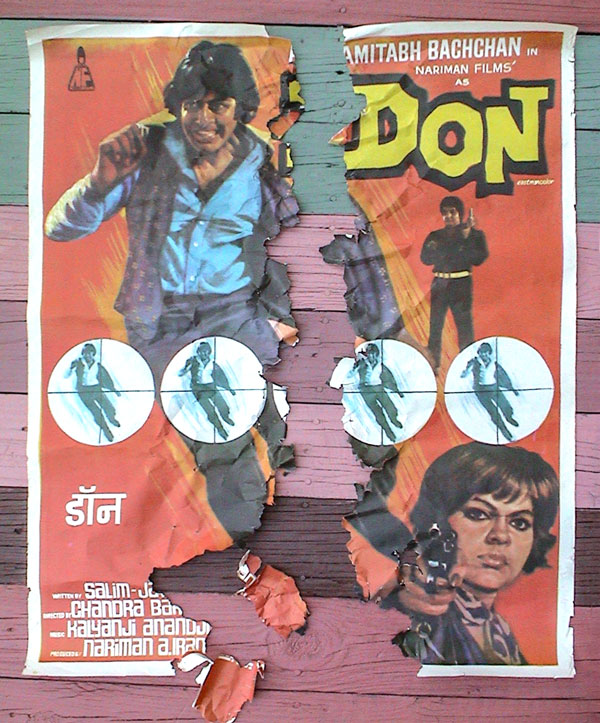
Don is a gangster, a really bad guy. He kills without compunction, loves without conscience, and probably isn't even nice to his mother (though we never know for sure—there are no mothers in Don, which is unusual for an Indian film of this period). Fortunately for the law-abiding citizens of Mumbai, Don is killed in a police ambush well before intermission. Thus the challenge for Inspector D'Silva (Iftekhar, a man who played cops so many times his name became a slang term for a policeman). Can he persuade a simple paan-chewing street entertainer from Benares—a man with an astonishing likeness to the real Don—to fake amnesia and take over the gang?
Aside from Amitabh's great double performance as bad ass and naive hero, there are many reasons to love this movie. Reason 1, the first five minutes: Don dispatches a trio of ruffians with an exploding briefcase—boom!—and we cut to a Bondian credit sequence with one of the grooviest title themes ever composed. The tremendous music in Don is by the team of Kalyanji Shah and Anandjit Shah, two brothers who scored dozens of movies, many of them the best disco-style tracks of the seventies. These guys are a major source for bhangra break-beat samples still filling dance floors (check out the great Bombay the Hard Way: Guns, Cars And Sitars mix CD). The team is always credited in Lennon-McCartney style as “Kalyanji-Anandji.”
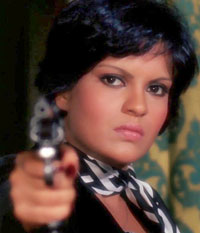 Reason 2: Amitabh's musical numbers. His first,
Bombay Nagaria,
is a paean to Bombay (...the
church
is missing at Churchgate...
) staged in a sandlot off Marine Drive with the city as a backdrop. Hundreds of residents watch as the Big B struts his stuff as a street entertainer barefoot in rustic garb. In Main Hoon Don
he's
in disco
gear in a nightclub, this time surrounded by bad guys and cool girlfriends (including Zeenat Aman, another reason to love this movie). Curiously, the song starts with Amitabh in a tiger mask.
(I’m clueless on the cultural background of this mask dancing, but it reminds me of what we used to call the cat dance
at Sonali, a tiny joint that was halfway down the Indian restaurant row in the East Village. Throughout the 80s
this block on 6th Street between First and Second Avenues had twenty-six Indian places, most with serviceable and cheap Bangladeshi cuisine. If you saw the occasional roach on the table, so what? Two could eat for less than twenty
dollars. If the staff at Sonali found out that it was your birthday, one of the kitchen boys was sent out in a plastic cat mask to dance while colored gels spun in front of a light fixture and a Bollywood number played on a cassette deck.
It was wonderful; I knew people who had three or four birthdays a year just to watch.)
Another classic number in Don is Khaike Paan Banaraswala
a hymn to the joys of the betel leaf. With opiate ruling your senses / chew a betel leaf / a betel-leaf from Benares opens up the mind.
Amitabh is in street
entertainer costume once again, rustic and barefoot, and his dancing is much more than a joy to watch: as one writer noted, it's a reason to go on living. It's not so much that he's good at it—while not ungainly, he's no Fred
Astaire—he's just so much
fun to watch.
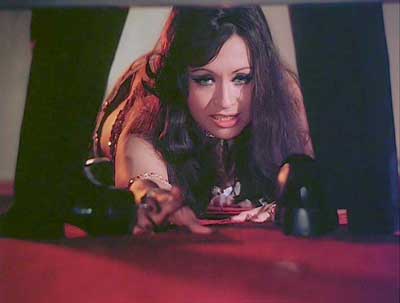 And finally Reason 3, the first song in the movie:
Yeh Mera Dil,
one of the biggest hits of one of
the great playback singers, Asha Bhosle. As they say in Bollywood, it is “picturized” on the eternal vamp Helen; she is seducing the bad
Don and playing for time as the police gather outside. While his back is turned she removes the bullets from his gun, but wait—there’s one on the floor, between his feet! Helen's legend says she was in a thousand films, though the
actual
number is probably closer to seven-hundred; she was a half-Burmese, half-French waif who walked with her mother from Burma to India to escape the Japanese during the Second World War. The original item girl, Helen often appears in a song
sequence that has no relation to the plot: the item number. Her dancing is like Cary Grant's accent, a self-invented compendium of styles. There’s no one like Helen in any other national cinema.
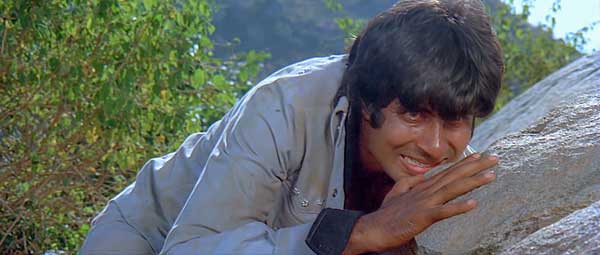
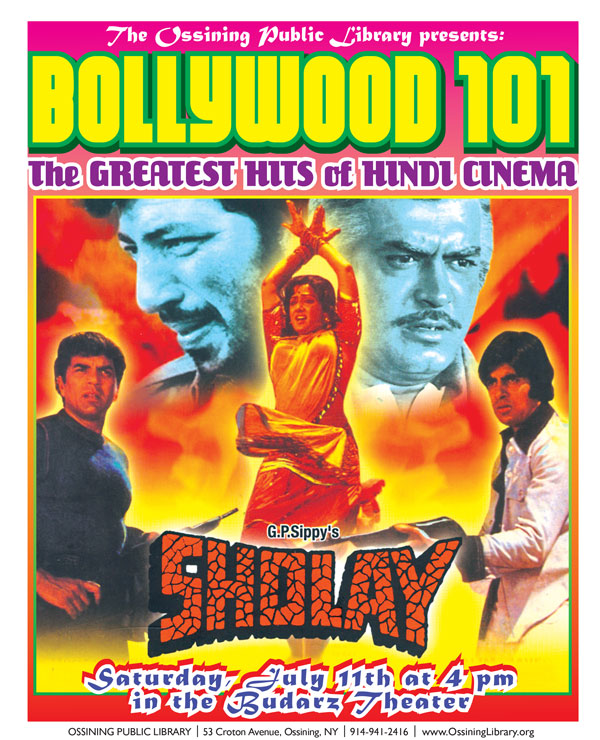
It's hard to write anything about Sholay that hasn't been written. There are books, articles, even movies about Sholay; there were hit LPs and cassettes in the 70s containing only snippets of dialogue from the soundtrack. Sholay is the ultimate Bollywood hit. It ran for five-and-a-half years in a first-run house in Mumbai—the people just kept coming, filling the theatre month after month. In 2005 Filmfare was still calling it the best film of the last fifty years; according to Wikipedia there are still over a thousand prints in circulation. In 2025 a restored version with the original, uncensored ending played major film festivals across Europe and the US.
Sholay didn't make Amitabh a star—Zanjeer had done that a few months before—but it solidified his place in the Bollywood firmament. The movie borrows liberally from Seven Samurai, though
it's most obvious
stylistic forbear is the spaghetti westerns of Sergio Leone. It's the story of two neer-do-wells rescued from prison by a former cop who needs their help: the town is threatened by a bandit gang led by the baddest bad guy of them all,
Ghabbar Singh. The legend goes that Indian mothers would get their children to settle down at night by saying, Go to sleep or Ghabbar Singh will come and get you!
Amjad Khan (pictured above) became an overnight sensation with the
role and was associated with bad guys (and Amitabh) for the rest of his career.
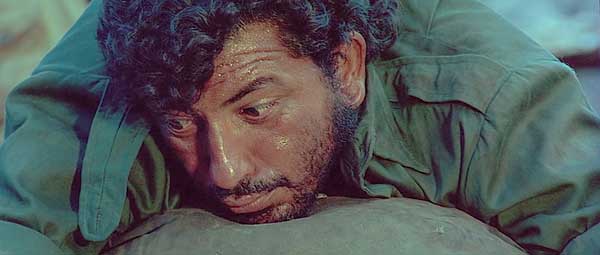
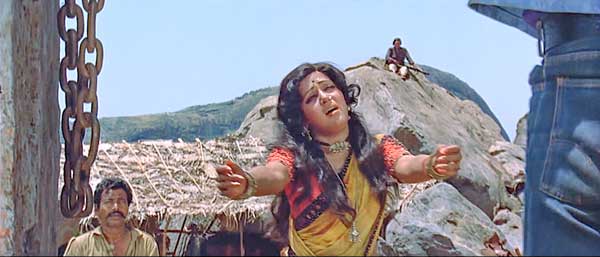
The stunt work was also innovative, using industry stuntmen recruited from the West to elevate the thrills
to a level never before seen; there is a fabulous attack on a train near the
beginning of the movie that looks like something from Lawrence of Arabia. Stunt-work in Bollywood was often amateurish before (and even after) Sholay, with Amitabh’s accident in Coolie providing
great impetus
for change. Before the shift Mumbai actors were often pressured into dangerous situations that their Western counterparts had avoided since Lilian Gish jumped ice floes for D.W. Griffith.
Like Star Wars in the US, Sholay was not only a mammoth hit but also extremely influential technically, providing a financial motivation to improve the way Hindi films were shot and projected. Though shot in 35mm the prints were masked at top and bottom and blown-up on 70mm stock, giving it a widescreen ratio that was almost unknown in India at the time. It also had the first stereo soundtrack.
In the 2020’s, Indian films throughout the five major film centers are technically indistinguishable from Hollwood, and Sholay still reigns as the quintessential Bollywood smash.
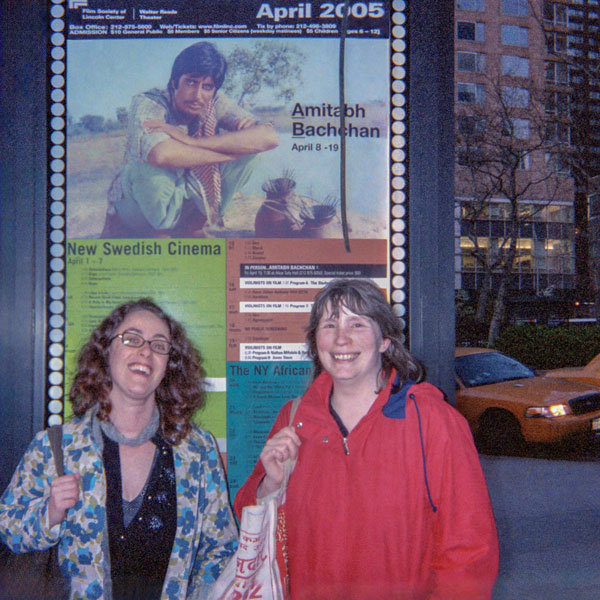
In April of 2005 Carolyn and I along with friend Alyssa attended An Evening with Amitabh Bachchan
at Lincoln Center. The appearance kicked off a restrospective of his films, one of the reasons I love New York.


We had a family gathering during one of our periodic visits to Columbus. Two young cousins are seen above outside of the Bogey Inn, the contemporary name for a bar that's been at the location for many years. The new name reflects the golf course ambience that metastasized across Dublin when Columbus-born golfer Jack Nicklaus built a course there.
When I was young my father drank there; none of the customers were remotely connected to leisure class sports. I remember killing time there with my brother. I remember a country music jukebox, the long neck beers, the ashtrays, and a puck-based bowling machine. I think it was called the Dam Shack or the Damn Shack, a pun; it was just a few yards from O'Shaughnessy Dam.
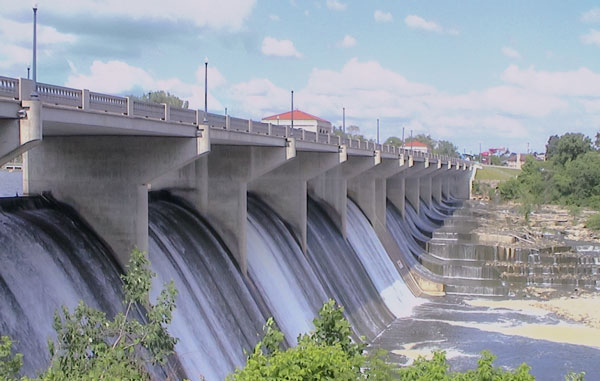
The place was less than a mile from our cottage. I've written about that memory, and I've written about the bar, the dam, the reservoir behind it, and the Zoo-Park across the water. See these items from 1965 and 1974.
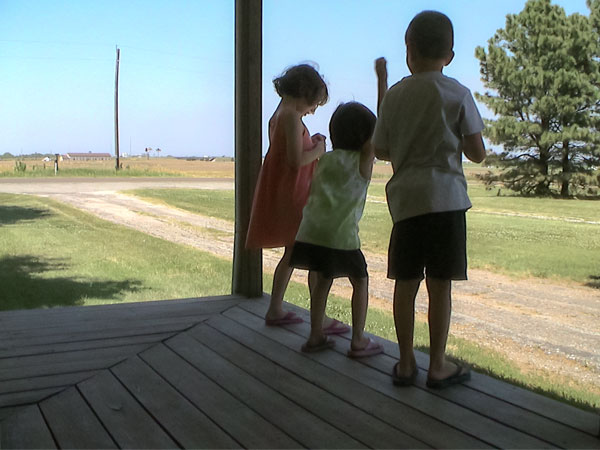
The laws about fireworks in Kansas are complicated: all sorts of devices are legal either all the time or around the July 4th holiday. Legal or not it was excruciating for me to sit on the porch and watch the kids setting them off. When one looks at the world as I do—through shit-colored glasses—every human activity is a source of anxiety. When the activity is actually dangerous my blood pressure gets as high as it used to be in the waiting room of my doctor's office, where the sadistic receptionist ran Fox News for us on the TV. Now in Kansas mom and the kids and the other parents—old friends of the family—weren't worried. I sat there in my bubble of tension. Somehow all fingers were intact at the time we left.
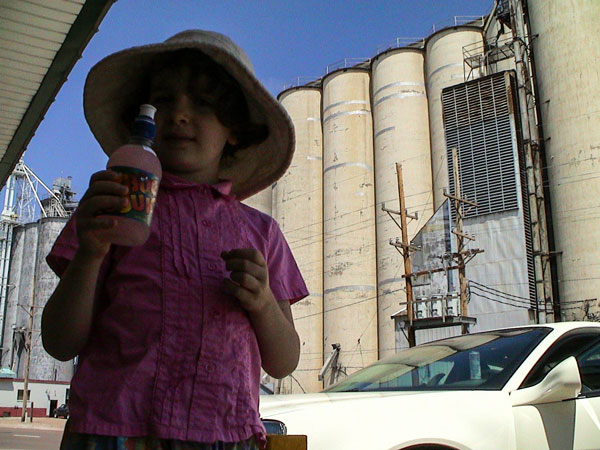
My wife grew up in Kansas in a town of twelve-thousand where the tallest structure was a grain elevator. Most people fly over the endless plains or see it as the long boring part of a cross-country drive. It has its own kind of beauty, though, the uninterrupted horizon letting you see the advancing weather twenty miles away. In my small apartment in Manhattan I remember the vistas from from the porch at Brian and Lindy's house.


It was a work trip for Carolyn and we came along. It was also a birthday for H, her sixth. We asked her what she wanted to eat and she said Sushi!
Before ice cream, before cake, before ravioli and peas and all the other things she
liked to
eat: sushi. She'd never had it before, and no one had any idea why she wanted it then. It's become a family tradition since.

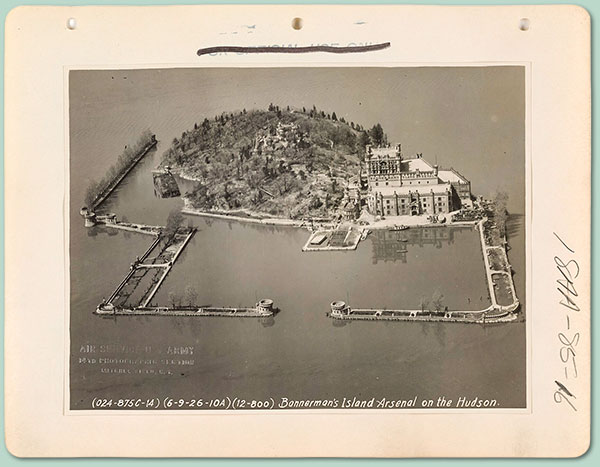
A common sight for those on the Hudson Line commuter train (or the Amtrak trains on the same track) the abandoned brick structure known as Bannerman Castle can be found just north of Cold Spring on Pollepel Island, close to the eastern shore. Arms merchant Francis Bannerman designed and started building the place in 1901; he used it to store the munitions that were the core of his business. It was unfinished at his death in 1918.
In 1920 a huge explosion ripped through the place; in 1969 there was a fire that destroyed the wooden floors and the roof. In 2009 one of the walls seen in photo above collapsed sometime during the night. It's a hard-hat kind of place; when I was walking around out there I was acutely aware of how near the end this old pile of bricks seemed to be.
The Bannerman Castle Trust owns the place and started to give tours during the summer. Looking for some kind of extra income I had begun to freelance for the Putnam County News and Recorder, Cold Spring's local paper. I didn't last very long at the job. After a couple of gigs covering local school board meetings—crushingly boring—I'd had enough. At least I got a chance to see the castle.

 |
 |