We drove from Columbus to the Adirondacks in a Cadillac owned by Jeff's dad during our senior year spring break. I'm in the bomber jacket standing next to Dan, Jeff right above him, and Mike is leaning on the back window. His family had
the cabin that was our destination.
Dan in Caddie
Shirtsleeve weatherPoncho in the housePosing on a mound of snow in front of the cabin
There was still a lot of snow in the Adirondacks in April (or May); we had to park the car on a plowed road about a quarter-mile from the cabin. At some point during the hike in from the road (especially difficult without snowshoes),
the
car keys were lost in the snow. The very next day a visiting friend making the same trek sank to his knees in the stuff and came up with the keys.
There was some drama on this trip, mostly provided by the two Mikes: me and Fogarty. We were determined to do some acid, and we had some tabs of windowpane. In Columbus this was primo dope: clean and powerful. I was expecting a lot and
got it: a lot of hallucinating, for instance. I was mostly standing in front of the fireplace; any movement of any part of my body was a matter of serious consideration, as I was aware of each corpuscle travelling through increasingly
narrower capillaries.
Tripping made me aware of how much day-to-day reality was a story my brain was telling me while it processed the gigabytes of sensory data incoming every second. It made me more sophisticated about how I perceived what was happening to
me, about what my senses were telling me, and about how I was parsing the data.
Jeff and Dan were opposed to us taking the drug. They were worried about the effect it might have on our still developing brains. On a trip it was possible make a trauma, to trigger something that looked like a car crash to a brain. I've
seen acid casualties; I've been with people who were having a bad trip (but never had one myself). But the Mikes figured most people taking the drug survived the experience, and we very much wanted the experience. The opposition ended up
as watchers, there to help. Did we suffer damage? Who knows.
High school newspaper about high school musical
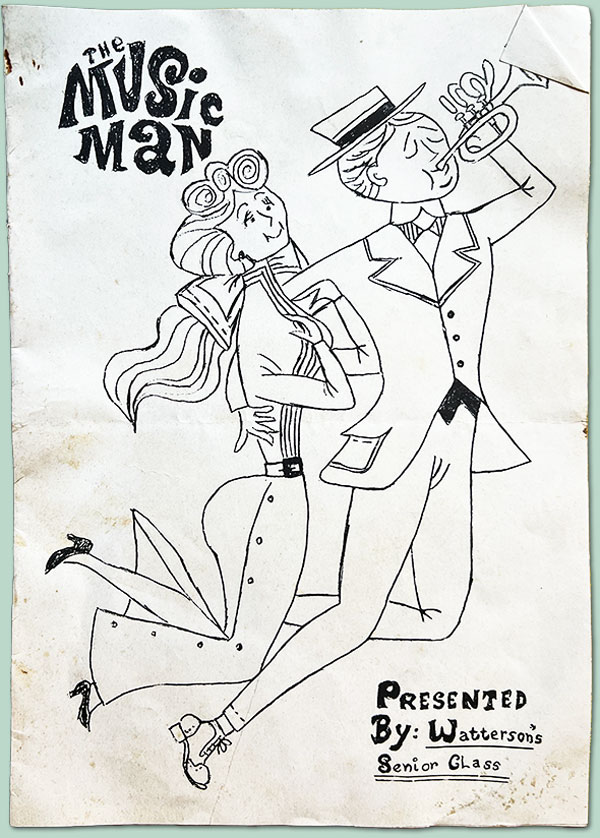
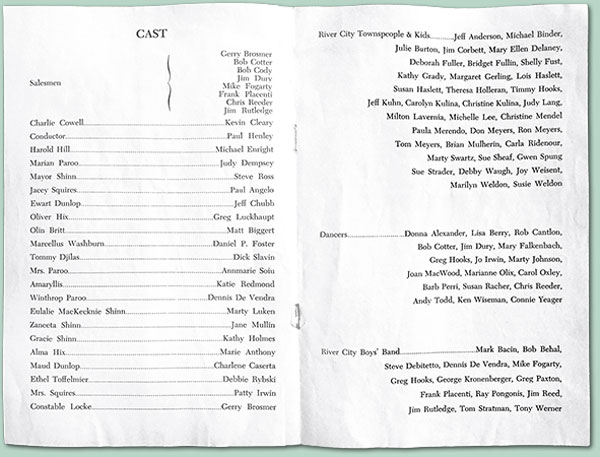
I was in our high school's production of The Music Man playing Harold Hill, a part I wanted more than I've ever wanted anything in my life. I'd seen the movie many times; it was a family tradition like The Wizard of
Oz or Yankee Doodle Dandy. It was perfect for me and I knew every Robert Preston minute in the picture. I did some assistant directing, though no one invited me to do so; one example was coaching the River City women's group through the Pick-a-Little, Talk-a-Little number. Was I annoying to everyone? I was really trying not to be an asshole.
It was, of course, an unusually good high school production, excellent in every possible way.
Watterson's Senior Class presents The Music ManProgram interior
In 2005 I worked on an article about audience appetite for corny movies in India vs. the USA. This excerpt seems appropriate.
It was 1962. My movie-crazy father took the family to the Columbus, Ohio, premier of The Music Man, the film version of Meredith Wilson's 1957 Broadway smash. In Columbus we didn't see many Broadway shows; for many in the audience,
the movie would be their only opportunity. We got the touring shows but not of everything, and not often; the first truly professional show I saw wasn't until 1970, a touring version of Hair. I went because I liked a couple of the songs and because there was such a local uproar about the nudity. I was into seeing the naked people, I admit, but even more important to the libertarian in me was to walk past the protesters. A similar impulse took me to the New York premiere of The Last
Temptation of Christ; I wanted to walk past the hard-Christian picket line outside the theater.
We were lucky enough in Columbus to have two surviving downtown dream theaters (both of which are still in use). The Music Man played the RKO Palace, a cavernous venue
located in the base of the LIncoln-Leveque Tower, the first skyscraper in the downtown skyline. The theater’s style was French Renaissance, the architect Thomas Lamb, the capacity almost three thousand. That night the place was packed.
It was obviously special-event programming; the seats were probably reserved, as they were in those days for the bigger films. I still have ticket stubs for The Sound of Music and 2001: A Space Odyssey, an event that was also my first
date. There was even live programming before the movie began, something that had been typical through the twenties and thirties and forties. By the sixties the combination of live acts and movies had almost completely disappeared, though I did manage to see the Jane Fonda/Robert Redford comedy Barefoot in the Park at Radio City during a 1967 trip to New York; the Rockettes danced before the show.
My father recalled seeing many A-list and B-list pictures at the Palace on the same program with a Dorsey brother or a Glenn Miller or an Artie Shaw, all with their accompanying orchestras and boy and girl singers. These shows were the
last gasp of vaudeville, a whole segment of American entertainment now completely forgotten. Seeing The Music Man in one of the two surviving palaces in Columbus was probably special for him and certainly special for kids like me, too young to have seen those shows. One felt the history.
As an appropriate opening for this particular film, the live part of the premiere was a barbershop quartet, The Buffalo Bills, one of the top old-timey quartets in the US and the one featured in the film. They performed
the songs they sang in the movie, “Good Night Ladies” and “Lida Rose,” and others from the barbershop repertoire. The applause was sustained after each number; we were really getting our money's worth.
Finally the quartet finished, the house lights dimmed, and the gigantic red velvet curtain—about a block long—parted to reveal the screen. It was so exciting! Admittedly, it would have been hard for The Music Man to be a
disappointment to entertainment-starved midwesterners. And it was no disappointment at all; instead it was absolutely thrilling, an emotional roller coaster that had us all laughing, crying, and jumping up in our
seats for a ten-minute standing ovation at the end.
A standing ovation for a movie! I’ve heard applause now and then but I’ve never seen anyone standing. I know it’s a ritual at Cannes now; ovation lengths are reported in the entertainment press. Still, this is nothing one sees at an AMC matinee, even in Manhattan.
I think this must have been what it was like to see an important opening in seventies Mumbai: a packed house of entire families, screaming children, young men throwing coins at the film idols on-screen, and everyone feeling entirely free
to comment aloud at each developing crisis ("But doctor, where will I get such dollars for the operation?"), and each musical number that all have memorized from constant street corner playback for weeks in advance.
Thank you speech to the Ohio Association of Broadcasters
They gave me a $500 scholarship; my dad had connections at the local CBS affiliate and somebody there submitted my name. I always enjoyed making speeches; that helped me later when I started teaching.
I scanned a print to capture this image; it's massively damaged. I've restored the faces but left the rest extant to show the original state. I don't care enough about the image to put in the hours it would take to rebuild it, and it
would have to be rebuilt rather than restored, like some Ship of Theseus. In this kind of work every part of the original is recreated. Whether overhauled by an AI algorithm or painstakingly assembled with mouse, monitor, and eyeball, it
would be inspired by (based on a true story) but not ultimately the real thing.
Ticket for The Who in Dayton, Ohio: one of the best live acts I've ever seen. And I grabbed a piece of Keith Moon's drumstick!The college years
Fate is at work in our dorm assignments. In my case the roommate was gone after a couple months; he was an actor who laughed a lot and hung out with a group of friends from high school. They seemed very young and irritating; I was glad
when they all moved out of my life and into another dorm. I had the place to myself for a few months but then was assigned a new roommate, a Cincinnati kid named Barry. He was an engineering major who hid his nerdiness well. Like all of
us, he had committed to a second major in pot smoking. We got along fine, so well we spent the next few years living together.
In the long term the dorm assignment was far more significant than the roommate. I spent years believing it was just one floor of one dorm like all the other dorms in the world of 1971. Looking back and researching this a bit, I no
longer
believe that. For better or worse, the place was unique.
Months out of high school and a world away. Photo by Barry Dreyling.
Charlie Manson in the dorm. I got my hair as long as possible as quickly as possible after graduating from that last Catholic school. Because of the dress code I was always the guy with the shortest hair in the band. I was also the bass
guitarist, so my live appearances were mostly anonymous. I played a dance for my own high school once and asked a girl in the audience how she liked my band. "Oh, that's your band?"