

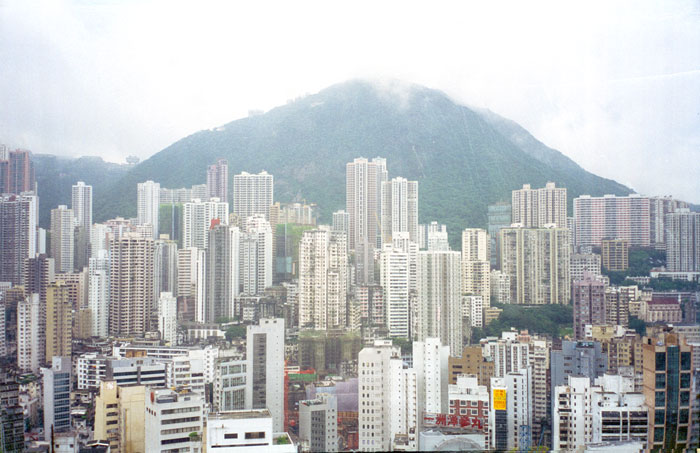
Hong Kong city view with Victoria Peak
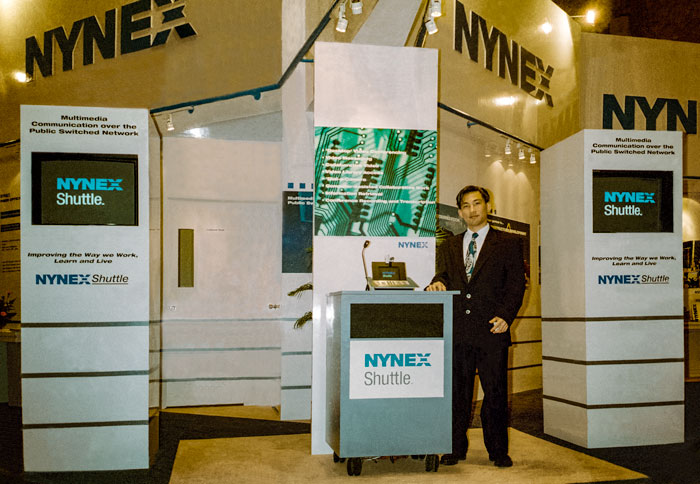
I got a job with NYNEX (the New York area phone company, now Verizon) in my second and final year in the Interactive Telecommunications Program at NYU. I was also a GA in the department this second year, which unfortunately meant I didn't get a great deal out of my classes.
I commuted most mornings from the East Village to White Plains and my job in a small development group. Everyone in that group had been hired out of ITP. We were designing interfaces for video on demand and demoing those interfaces at trade shows. The programming was all done through Apple's Hypercard and third-party widgets that connected with Hypercard. Through the touch-screen we faked the video streams that were actually being read from a laser disk. Sometimes I shot those videos, even hiring actors I'd used in my own videos (where nobody got paid) like The Look of Love.
We showed these demos all over the world; this particular trip was to Singapore and included a stopover in Hong Kong on the way back home. Singapore didn't impress me; too much of the old city was gone to make room for the office buildings that reminded me of White Plains. I did love the stacks of satay with peanut sauce I got in the outdoor food courts; I vividly recall the peculiar smell and taste of durian.
Hong Kong, however, was unimaginable, a city out of a dream. I've never seen anyplace like Hong Kong, not then and not since—only Kolkata comes close. In every direction there are thousands of people, hundreds of side streets little wider than alleys crammed with signage and neon and during my visit, umbrellas. Suddenly you're jumping out of the way of a streetcar. Hovering over it all is Victoria Peak; you imagine the dragons rushing down the slope to the harbor through the carefully-designed feng-shui passageways. There is a skyscraper bridging an empty space in the lower floors so the spirits are not impeded. It is the true model for the production design of Blade Runner, (rain included). It was still under British control at the time though there wasn't much to indicate it. Of course I got a suit made.
At the time NYNEX engineers knew that video wasn't going to arrive through twisted-pair copper, the infrastructure that had handled phone calls since the days of Alexander Graham Bell. The whole industry was waiting for developments that were only slowly introduced—faster processors, faster modems, fiber-optic cables, and tremendous advances in compression. All of this eventually arrived and became streaming video.
After several years at NYNEX I went to work developing mass-market CD-ROM reference disks for Macmillan Digital. It was early attempt by a publishing house to make money from the new electronic media. Publishing still hasn't really figured out how to do that.